Parenting for the 21st Century
The Patrol Family Playbook
Definition
Patrol [puh-trohl]
a group of people with individual responsibilities and a common mission.
Mnemonic
- P
- Parent-Led
- A
- Agency-Oriented
- T
- Targets Tied to Missions
- R
- Rhythmic Approach
- O
- Orienting Over Ordering
- L
- Lasting Memories
One loop, run on repeat
- 1
The Nightly Tally — seconds
Nightly, every member: tally routine completion and mission progress, and drop in anything worth discussing at the next family council.
- 2
The Parent Council — ~10 min
Run one family with your spouse instead of two overlapping households: review the week, plan each kid’s council, set the family council agenda.
- 3
Personal Councils — ~5 min each
One on one with each kid: chores get paid, missions get discussed, next week gets inspired.
- 4
The Family Council — ~20 min
The whole patrol: camaraderie first, review the family’s progress, align on the coming week’s missions. Kids bring items, and items get decided.
The loop is the engine. Routines and missions are what it drives.
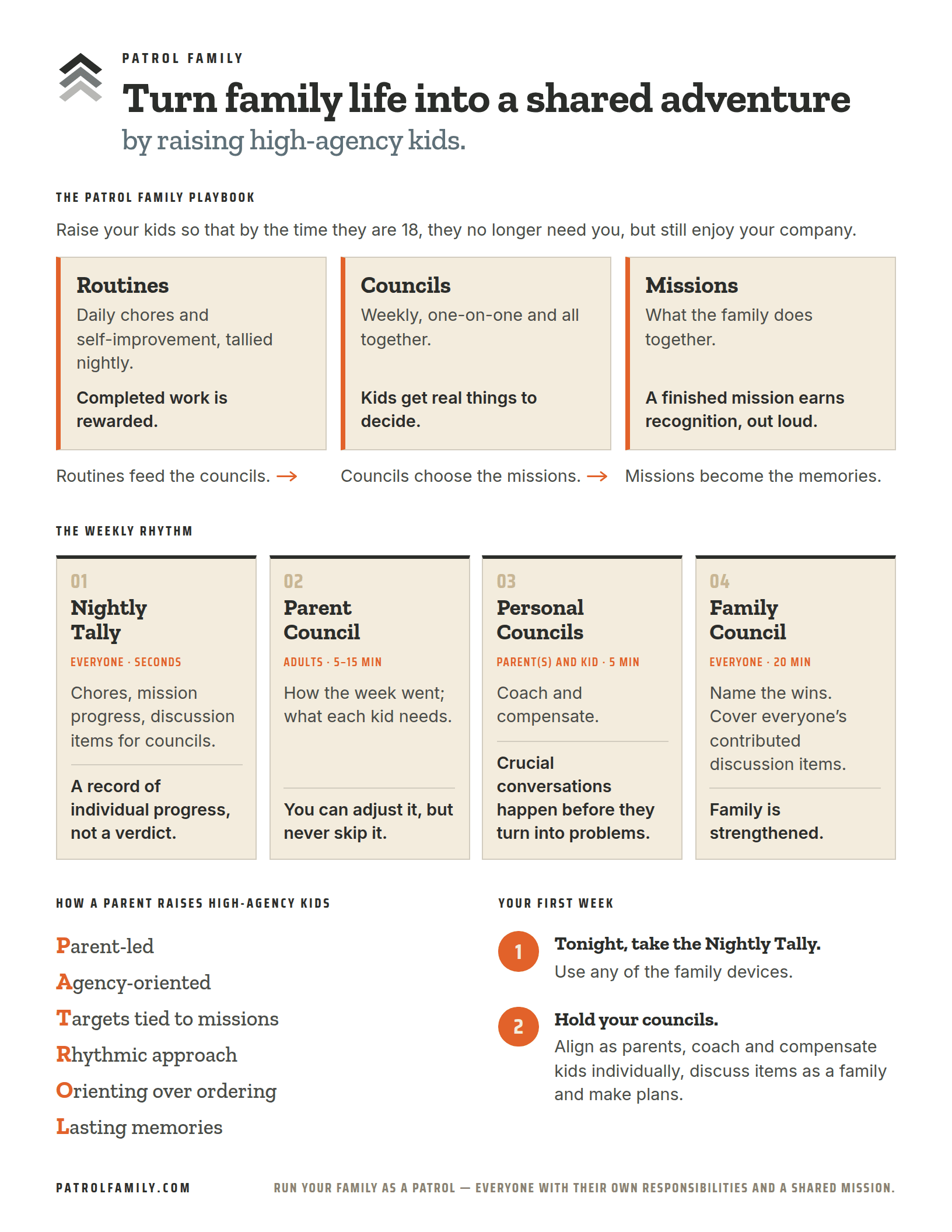
THE PLAYBOOK, ON ONE PAGE
The whole method on a sheet you can magnet to the fridge.
The three things — routines, councils, missions — the four appointments, how a parent leads, and your first week. On one page for the fridge. It’s the reminder; the app is where it runs.
The life skill of the 21st century.
What we mean by agency
Not confidence. Not compliance. Not a personality type. Five plain things:
- Believes acting works. They’ve seen their own effort change an outcome enough times to expect it.
- Wants things of their own. Not everything they chase was handed to them by an adult.
- Will ask, try, be told no, and still find a way. The ask is the muscle most kids never train.
- Can do hard things — and invent a path when there isn’t one.
- Finishes what they start.
Agency for what? For service, for their family, and eventually for a patrol of their own.
This whole system hands kids the responsibilities from which agency grows, early and often enough that acting becomes the thing they expect to do.

Get chores out of the way…
- 20
- Months
- 3,071
- Jobs logged & paid
- $3,413
- Earned in real work
- 2 kids (w/ chores)
- One system
A snapshot — from the first logged job through April 2026.
Earnings over time
20 monthsWith maturity comes higher-value work — as kids grow they take on the bigger-ticket jobs: mowing the lawn, washing the car. The work, and the pay, grow up with them.
What the work was
Both kids- Played 30 min with baby sister521
- Dressed & fed baby sister243
- Went on 30 min walk with baby sister198
- Read 10 min to baby sister161
- Vacuumed a room135
- Cleaned their room97
- Folded laundry97
- Filled the water filter75
- All other chores1,544
- Books finished*45
*Roughly 12,000 pages.
Routines
Routines are the key to compounding returns on all aspects of personal, home, and family life.
Missions
…Then seize the day!
A mission breaks into targets, and each target breaks into tasks. Anyone in the family can bring an idea, and the family plans it and commits to it in council.
Work & Home · a few weeks · Service Campaign
Give on Purpose
Targets
- Pick it, and check it out before you trust it
- Choose a cause you actually care about, and say out loud why it matters to you
- Find out where the money actually goes, who runs it, and whether they're trusted
- Decide how much of your own money to give — based on what you found, not on the name
- Give it, and be able to say who it helped
- Make the gift for real, from money you earned or saved, and keep the receipt
- Find out who your gift actually helps
- Tell the family the story in your own words — why this one, and what you hope it changes
- Earn a second gift, and give it unseen
- Do the work to earn a second gift, separate from the first
- Make that gift without announcing it — no post, no telling, no credit
- Say afterward what it felt like to give when nothing came back
Missions
Completing missions is key to living a life of meaning, with purpose, and anti-fragility. It’s a pattern you’ll see in high-agency people, and a skill that stands out in a world of AI.
Turn family life into a shared adventure.
See the Patrol Family Playbook demonstrated.
How to Run a Family Council (The Agenda Writes Itself)